Best essential oils to anoint candles for love spells
Rose, jasmine, ylang ylang, lavender and more: what each oil means, how to dress a candle safely, how much to use and which cautions matter most.
Which essential oils are best to anoint a candle for love?
The oils most used to anoint love candles are rose for tenderness, jasmine for sensual attraction, ylang ylang for warmth, lavender for calm, vanilla for comfort and sandalwood for grounded devotion. Anointing means rubbing a very small, diluted amount of oil along the candle while holding your intention. Oils are potent and flammable, so dilution, small quantities and fire safety matter more than which oil you choose.
When love begins to fade, the pain can feel unbearable. Also, you may lie awake wondering what went wrong, whether they still think of you, and whether the two of you can restore the bond. I understand this pain. Of course, for more than 30 years, I have helped people heal broken relationships and reopen the door to love.
Walk into any shop that sells candles and incense and the shelves are crowded with little bottles. Rose, jasmine, ylang ylang, patchouli, musk, a dozen blends with names like Attraction and Come to Me. After all, it is easy to feel that choosing the right oil is the secret of a love spell.
In my experience it is not. Also, the secret is attention and kindness. But oils are a beautiful part of ritual, and used well they add scent, mood and a sense of care. Indeed, in this article I will explain how to anoint a candle, which oils suit which intentions, how to dilute and handle them safely and what they can and cannot do.

What anointing means
To anoint a candle is to dress it with oil. Traditionally, you hold the candle by the middle and rub oil from the center toward the top, then from the center toward the bottom, while holding your intention in mind. After all, this movement is thought to draw your wish into the candle and then to send it out.
In many traditions, anointing is also a way of making an object yours. Also, the oil carries your touch, your scent and your attention. Indeed, when you light the candle, it holds those things. Whether you view this literally or as a psychological anchor, the effect is a deeper sense of presence in the ritual.
You do not need to anoint a candle for it to work. Indeed, a plain candle, lit with a kind wish, is a perfectly good ritual. Oils are an optional layer that some people love and others skip.
What oils can honestly do
An oil cannot send desire into another person’s heart. Also, our work is intended to influence the heart, mind, and emotional connection, and scent works on your own mood: calming, brightening, softening. That is its honest gift.
| Oils can help with | They cannot do |
|---|---|
| Setting a mood of tenderness or calm | Make anyone love you |
| Marking the ritual as special | Control another person |
| Anchoring memory and intention | Replace honest effort |
| Giving a sensory pleasure | Guarantee any result |
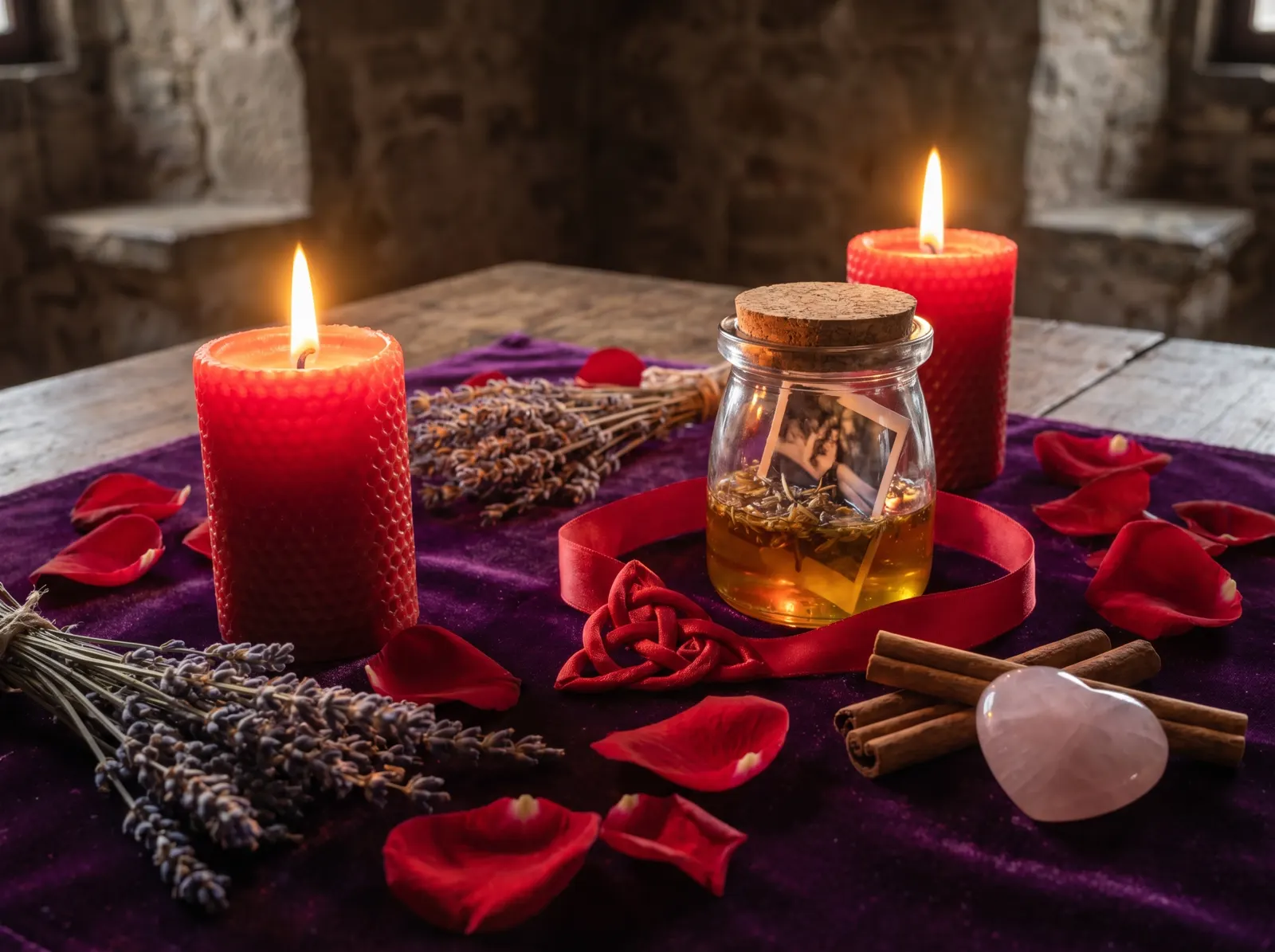
Essential oil safety, first and always
Essential oils are concentrated plant extracts. They deserve respect.
- Never swallow essential oils.
- Always dilute in a carrier oil such as olive, sweet almond or jojoba before touching skin. A safe starting ratio is about 1 to 2 percent: roughly 6 to 12 drops per ounce (30 ml).
- Test a tiny amount on your forearm and wait a day for any reaction.
- Keep oils away from eyes, mucous membranes, children and pets, especially cats.
- Avoid some oils in pregnancy or with medical conditions; ask a doctor.
- Oils are flammable. Use a very thin layer on a candle, never near the wick.
- Wash your hands after anointing, before touching your face.
If an oil irritates you, stop using it. Of course, a beautiful ritual should never cost you a rash or a headache.
How to dilute and prepare an anointing oil
- Choose a carrier oil such as olive, sweet almond or jojoba. Pour a tablespoon (15 ml) into a small clean dish or bottle.
- Add 3 to 6 drops of one essential oil, or 2 drops each of two.
- Stir gently with a clean toothpick or swirl the bottle.
- Label the bottle with the date and oils used.
- Store it in a cool, dark place. Use within a few months.
This small batch is more than enough for many rituals. Do not use pure essential oil directly on a candle or your skin.

Rose: tenderness and the heart
Rose is the classic oil of love. Indeed, its scent is sweet, floral and deeply comforting. Still, it is associated with the heart, tenderness, self-love and romantic devotion. It is often the first choice for a candle intended to soften and warm a relationship.
Real rose oil is costly because it takes a vast quantity of petals to make a little. Of course, many shops sell rose fragrance oil or a diluted blend. In fact, these are fine for ritual, as long as you know which you have and handle them properly. A drop or two goes a long way. Use rose when you want gentleness, affection and a sense of being cherished.
Jasmine: sensual attraction
Jasmine is a heady, intoxicating floral scent, long linked with romance and sensual attraction. In fact, it is the flower of evening, opening and releasing its perfume after sunset. Indeed, in ritual it suits intentions of passion, magnetism and welcoming new connection.
Because it is strong, use jasmine sparingly. Also, a single drop in a carrier oil is often enough. It pairs well with rose for a romantic evening or with sandalwood for a deeper, grounded tone. Also, if you find jasmine overwhelming, try neroli or orange blossom, which have a lighter feel.
Ylang ylang: warmth and openness
Ylang ylang has a creamy, sweet and slightly exotic fragrance. Still, it is traditionally associated with warmth, sensuality and the opening of the heart. Also, for people who feel guarded or tense, a candle anointed with a little ylang ylang can set a mood of ease and receptivity.
It is quite strong and can cause headaches in some people. Use only a tiny amount, and open a window. Blend it with lavender for a softer effect. Also, if you are sensitive to strong scents, skip it.

Lavender: calm and peace
Lavender is gentle and widely loved. Of course, its soothing scent is linked with calm, rest and peace, and is a fine choice after a quarrel, during a time of stress or when you are feeling anxious about love. Also, a lavender candle says: I am safe to be soft.
It blends beautifully with rose and chamomile. In fact, it is also one of the milder oils for skin, though dilution is still needed. Lavender is a good first oil for beginners because it is forgiving, easy to find and pleasant.
Vanilla: comfort and familiarity
Vanilla smells like home. Still, it is associated with comfort, affection and the warmth of long relationships. Also, for couples who have drifted into routine, a vanilla-anointed candle can evoke gentleness and shared memory.
Look for real vanilla absolute or oleoresin, or a vanilla-infused carrier oil, which is lovely and safe. Synthetic vanilla fragrance oils are common and work for scent, but check the label if you have sensitive skin. Also, a little vanilla on a candle makes the room feel kind.
Sandalwood: grounded devotion
Sandalwood has a warm, woody, calming scent. Of course, in many traditions it is used for meditation and prayer, and it is associated with devotion, grounding and spiritual love. In fact, it is a good choice when you want a ritual to feel steady and deep.
True sandalwood oil is costly and the tree is endangered in some regions, so choose responsibly sourced oil or a substitute such as cedarwood or a sandalwood-scented blend. Also, a single drop in carrier oil is enough.
Other oils worth knowing
A few other oils appear often in love rituals. Bergamot is bright and uplifting, linked with joy and confidence. Neroli is delicate, calming and romantic. Geranium is rosy and balancing. Patchouli is earthy and sensual, loved by some and disliked by others. Cardamom and ginger add warmth and a spark.
Each of these can be used in the same careful way. Choose one or two, not many. Of course, a simple blend is easier to understand, and it leaves less room for sensitivity or confusion. Also, if you are unsure, begin with rose and lavender and add others over time.
Oils for different intentions
| Intention | Oils to consider |
|---|---|
| Self-love and tenderness | Rose, geranium, vanilla |
| Calm after conflict | Lavender, chamomile, neroli |
| New attraction | Jasmine, ylang ylang, bergamot |
| Warmth in a long relationship | Vanilla, sandalwood, cardamom |
| Courage to speak | Bergamot, ginger, cinnamon (very small amounts) |
| Healing after loss | Rose, lavender, frankincense |
Use these as a loose guide. Follow your nose, because a scent you love will lift your mood more than one you do not.
How to anoint a candle, step by step
- Clean the candle with a dry cloth. Place it on a plate.
- Prepare your oil in a small dish, diluted as above.
- Take three slow breaths and think of your intention.
- Dip your fingertip in the oil, just a little.
- Rub the candle from the center to the top, avoiding the wick. Then from the center to the bottom.
- Say your intention aloud.
- Wipe your fingers on a cloth and wash your hands.
- Place the candle in a holder and light it with care.
The oil layer should be so thin you can barely see it. Also, a thick coat can drip and flare. Never put oil on the wick.

Fire safety with oiled candles
Oil on a candle adds scent and a small increase in fire risk. Keep these points in mind.
- Use a very thin layer, away from the wick.
- Never leave a lit candle unattended.
- Keep candles away from curtains, paper and bedding.
- Use a heat-proof holder on a stable surface.
- Keep a bowl of water or a damp cloth nearby.
- Do not burn anointed candles near children or pets unsupervised.
- Snuff the candle with a snuffer, not by blowing.
If you cannot burn a flame, you can still use oil: a drop on a cotton ball in a small dish near a window releases a gentle scent.
Using oils without candles
Oils work beautifully without fire. Add a drop of lavender to a pillow spray. Put two drops of diluted rose on a cotton pad and tuck it in a drawer. Place a few drops on a stone in a small diffuser. Wear a roll-on blend of jojoba and rose on your wrists, after patch testing.
These everyday uses make the scent part of your day, not only your ritual. Of course, a person who walks through the world gently scented with something they love often feels more at ease, and ease is the best thing to bring to love.

A story, in outline
This is a composite, not a single client, and details are changed.
A woman in New Orleans wrote to me after buying an expensive spray labeled Come To Me. Indeed, she wanted to know if it would draw a man she liked. Of course, I explained what oils can and cannot do, and showed her a simple recipe: lavender and rose in jojoba, rubbed lightly on a white candle.
She made it, lit the candle each evening for a week and found the scent calmed her. Of course, she also said hello to the man at a neighborhood event. They began talking. Indeed, the oil did not draw him. Still, it helped her relax enough to talk. It is a pattern, not a promise.
Is it ethical to use oils in a love ritual?
Oils used for your own mood and intention are ethical. Oils applied to another person’s belongings, bedding or body without their knowledge are not. Of course, our work is intended to influence the heart, mind, and emotional connection, and it never replaces choice.
Read the guide on ethical guidelines and the article on free will.
Common mistakes
The same few mistakes appear again and again.
- Using undiluted oil on skin or candles.
- Buying many oils and using none.
- Putting oil on the wick.
- Choosing a scent you dislike because a list recommended it.
- Expecting a scent to attract a specific person.
If you recognize one, begin again with a single oil and a simple wish.
Buying good oils
Quality varies widely. Look for bottles labeled with the Latin plant name, purity and country of origin. Dark glass bottles protect oils from light. Avoid products labeled only fragrance if you want a natural oil, though fragrance oils are fine for scent. Prices that seem too good for rose or sandalwood usually mean a blend or a synthetic.
Start small. Buy one or two oils you love, and learn them well. Indeed, a tiny bottle can last a year of rituals, and a short list of oils is easier to store, handle and understand.
A closing thought
The best oil for a love candle is the one that makes you feel kind. Choose it with your nose, dilute it with care, apply it with attention and light the flame with a simple wish.
The rest is the work of ordinary days: honest words, patient steps, an open door. Also, the oil is a lovely companion on that road, not a replacement for walking it.
When to ask for help
If you are unsure which oils suit you, if you have sensitivities or if you simply want an honest outside view, Baba Ali offers a free, private consultation. Of course, he will listen, tell you what he sees and explain what, if anything, fits. Also, you pay only for ritual materials, and unused materials are refunded in full.
A short history of scent in love and ritual
Perfume and love have been linked for as long as there are records. Egyptian priestesses blended fragrant oils for temples and for lovers. Greek and Roman poets sang of rose petals and myrrh. Persian gardens were designed around scent. Across Africa, aromatic woods, resins and flowers have been burned and rubbed on the body for ceremony and courtship.
Scent reaches the brain faster than most senses, and it is wired to memory and emotion. Also, a fragrance can bring back a summer, a kitchen, a first kiss. After all, this is why oils feel magical. They do not act on other people. After all, they act on us, calling up feelings that make us softer and more present.
When you anoint a candle with rose or lavender, you join this very long tradition of using scent to say what words cannot. Also, you can do so with joy, as long as you remember that the effect lives in you.
Blends to try
| Name | Recipe (per tablespoon of carrier oil) | Mood |
|---|---|---|
| Gentle heart | 3 drops rose, 2 drops lavender | Tenderness and calm |
| Open door | 3 drops bergamot, 2 drops jasmine | Brightness and welcome |
| Warm home | 3 drops vanilla, 2 drops sandalwood | Comfort and grounding |
| Evening romance | 2 drops ylang ylang, 2 drops rose, 1 drop cardamom | Warmth and sensual ease |
| Courage | 3 drops bergamot, 1 drop ginger | Confidence and lift |
These are starting points. Adjust to your nose and your skin. Keep each blend simple, and write down what you used so you can repeat or change it.
Questions readers ask me about oils
“Do I need expensive oils?” No. Of course, a modest bottle of lavender or a fragrance oil you love will do. Quality matters for skin safety, not for magic.
“Can I use oil on my partner’s pillow?” Only with their knowledge and agreement. Hidden scents are a violation of trust, and some people react badly.
“What if I am allergic to a fragrance?” Avoid it. Choose a different oil or use dried herbs instead.
“Can I use the same oil for every ritual?” Yes. Indeed, a signature scent can become a gentle anchor for your practice.
Storing, labeling and caring for your oils
Oils last longest in dark glass bottles with tight lids, stored in a cool place away from sun and heat. Also, a drawer or cupboard is ideal. Label each bottle with its name and the date you opened it. Of course, most essential oils keep their best scent for a year or two; citrus oils fade faster. Also, if an oil smells sharp, rancid or off, discard it.
Keep your oils away from children and pets, and out of reach of anyone who might mistake them for something drinkable. Also, when you finish with a diluted blend, pour out any leftover and wash the bottle. Fresh blends smell better and are safer. Of course, a small, tidy collection that you use is worth more than a drawer of forgotten bottles.
Oils and pets, children and pregnancy
Some oils are unsafe around animals. Cats in particular are very sensitive to many essential oils, including tea tree, citrus and some florals. Indeed, if you share your home with animals, keep oils out of their reach, avoid diffusing in closed rooms and ask your vet if you are unsure.
Young children are also sensitive. Keep bottles locked away and do not use strong oils in a child’s room. During pregnancy and breastfeeding, some oils should be avoided. Ask a doctor or midwife before using anything on your skin or in a diffuser. Also, a ritual should never put anyone in your household at risk.
A gentle evening using oils
Make a small pot of tea and sit by a window. Dilute a drop of lavender in a spoon of jojoba. Rub a little on your wrists and take three slow breaths of the scent. Light a white candle, anointed lightly with the same oil, and say a wish for ease. Sit for ten minutes. Snuff the candle and wash your hands.
Notice how you feel. Of course, many people find that a small scent ritual does more for their mood than they expect. In fact, it lowers the shoulders and slows the pulse. A calmer person is a better friend, partner and listener, which is exactly the sort of person love finds.
Fragrance memory and how to use it kindly
Because scent is tied so closely to memory, an oil you use for a ritual may come to remind you of that ritual. In fact, that can be lovely: the smell of lavender brings back the calm you felt on the best evening. After all, it can also be painful, if you used a scent during a bad period and now it recalls grief. If that happens, retire the scent for a while.
You can also choose a scent deliberately for an upcoming season of life. Start using a particular oil when you begin a new routine, a new job, a new friendship. Over weeks it will come to mean fresh beginnings. Indeed, when the day comes that you need courage, you will have a small bottle that carries it.
When to skip oils altogether
There will be times when a ritual is better without oil: when you are ill, when your skin is irritated, when a headache sits behind your eyes, when you are feeling overwhelmed by scent. Also, in those times, a plain candle, a glass of water and a quiet breath do just as well.
Do not feel that a ritual is incomplete without a perfume. Of course, the heart of any practice is attention and kindness, and those need no bottle at all.
Where to go next: services, guides and cities
If this article touched something real for you, these pages go deeper. Indeed, each one is written in the same plain, careful way.
Related services
Related guides
Cities Baba Ali serves
When it is better to ask Baba Ali directly
Reading helps, and some situations still need someone who can look at your whole story. Baba Ali offers a free, private consultation by phone, WhatsApp or the contact form, with no obligation. Also, if you go ahead, you pay only for the ritual materials, named item by item, and unused materials are refunded in full. Support is open 24/7 by chat, and calls are answered within 24 hours.
More from the blog
Keep reading with these related articles:
Questions people ask
What are the best essential oils for love candles?
Rose for tenderness, jasmine for attraction, ylang ylang for warmth, lavender for calm, vanilla for comfort and sandalwood for grounded devotion.
How do you anoint a candle?
Dilute oil in a carrier, rub a very thin layer from the center to the top and then to the bottom, avoiding the wick, while saying your intention.
How much essential oil should I use?
Dilute to about 1 to 2 percent in a carrier oil. A few drops per tablespoon is plenty.
Is it safe to put essential oils on a candle?
With a very thin layer, away from the wick, and never leaving it unattended.
Can I use essential oils on my skin?
Only diluted, and after a patch test. Never swallow essential oils.
Which oil is best for beginners?
Lavender, because it is gentle, easy to find and pleasant. Rose is a lovely second choice.
Can I use fragrance oils instead?
Yes for scent. Check labels if you have sensitive skin, and note they are not natural essential oils.
Will an oil make someone love me?
No. Oils work on your own mood and focus. They cannot compel another person.
Can Baba Ali help me choose?
Yes. Baba Ali offers a free consultation and gentle ritual guidance, with you paying only for materials.
Tell me about your situation
Call or WhatsApp Baba Ali now. Of course, the first conversation is free, and everything you say stays private.